
Probleme und Lösungen > Food Scarceness – an Example from Nigeria
Topic: Pastoralism and Challenges of Sourcing Grazing Resources around Dadin Kowa, Gombe State, Nigeria
Introduction
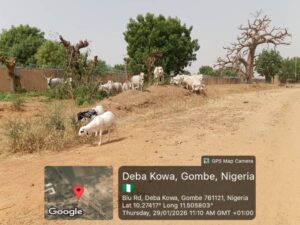
Many people practice pastoralism in African Savannah. A dominant traditional way of maintaining subsistence way of life, raising animals and cultivating surrounding farmlands. Nomadic people have been traditionally known with keeping livestock and roaming about in search for pasture and water for their animals. The concept of Common Property Resources (CPRs) are harnessed to the maximum, with most of the pastoralist hardly investing in producing pasture resources or doing anything for value addition in the CPRs.
The Study Area
Dadin Kowa, a town NE of Gombe, the capital of Gombe State, Nigeria, lies between Longitude 11°.31’ E and Latitude 10°.18’ N. The area has yearly average temperature of 26 °C and rainfall of between 835 mm to 1200 mm per annum (Agboola, 1979, Ibeje and Okoro, 2013) It has Savannah vegetal cover that strives in a well-drained soil of the one in Gongola valley. Most soils of Dadin Kowa are “having a pH of 6.5 as established by MONOCOT & DICOT Farms,” after conducting a pH test within farm sites located in the area (Gwani, 2017). This finding was corroborated by Dadin Kowa area sampled soil testing at the Department of Soil Science, University of Maiduguri (NE Nigeria) on 21st February, 2018 showing a pH of 6.4, N of 0.20%, P of 4.90 mg/kg and K of 0.50 Cmol + /kg values respectively. The general textural class of the soil was found to be silt loam a typical characteristics of soils found in river valleys similar to the study area, that promotes growth of variety of savannah grasses for grazing (Fieldwork, 2025).
Pastoralists in and around Dadin Kowa
Pastoralists in and around Dadin Kowa area, rearing cattle, goats and sheep, are into three distinct groups: Those roaming about with their animals around farms and community grazing areas in search for pasture and water. Those letting their animals wander freely from morning to dusk in community grazing and the third group are those that will keep their few livestock within households and be providing them with pasture and water. Grazing animals had been very traditional in and around the study area. Most pastoralists rely on indigenous knowledge to raise their stocks, very few rely on veterinary services, where obtainable, to address challenges of animal diseases or outbreaks of life threatening diseases. During rainy season, usually from June to early October, livestock grazed well on natural grasses and other shrubs, due to availability of rainfall. Farmlands cultivated by farmers, and usually livestock are restricted by traditional mechanisms from allowing pastoralist graze near the farms, in order to forestall conflict between farmers and herders. Pastoralists are at liberty after harvest to utilize crops residues on farmlands free of charge or to some extent purchase from farmers for a negotiated fee. There had been instances where some pastoralists use moonlight periods to graze their animals in the night, violating all traditional mechanisms of protecting farm produce and igniting conflicts between farmers and suspected herders. All these scenarios are evident that grazing resources are not enough to go round the immediate demand of the pastoralist (Fieldwork, 2025).
Dwindling Grazing Resources

Physical and human activities are interplaying and seriously affecting the availability of grazing resources in the study area (Ibrahim, Mayomi and Hashidu, 2022). Development induced clearing of vegetal cover for expanding farming programme and industrial activities, as witnessed in the study area has brought about many challenges in terms of dwindling natural and manufactured supply of grazing resources.
With dwindling grazing resources in and around Dadin Kowa, pastoralist are facing many challenges in getting readily affordable pasture. In the last 20 years, grazing resources are easily sourced from CPRs within the locality. With pressure on these resources coupled with effects of climate change, that causes erratic rainfall patterns and over exploitation of forest resources from the nearby Yamaltu Forest, many pastoralists are left to their devices and coping strategies to provide their animals with pasture either natural or manufactured (Fieldwork, 2025). Farmlands within and around the study area, Dadin Kowa, once after harvesting cereals like rice, sorghum, millet and maize, pastoralist will have crop residues as another source of pasture. Some farmers will leave the farm free for all to graze their animals, while other farmers will sell the crop residues at affordable prices to the pastoralists. Some pastoralists, especially those rearing cows, will travel to other places and purchase crop residues for storing, as a backup in the dry season when animal feeds are difficult to come by (Fieldwork, 2025).
Conclusion
To sum up, pastoralists in the study area, Dadin Kowa Gombe State, Nigeria are struggling hard to cope with scarcity of grazing resources and increasing number of livestock. Falling rainfall patterns are persistently changing with lower records as compared to previous years. This development makes pastoralists to be exploring various coping strategies in effort to overcome these daunting challenges. It can be safely recommended that pastoralists can do well, where obtainable, to engage in commercial pasture production to cater for increase demand by pastoralists in order to cater for their livestock. The private sector can also make investments in producing animal feeds to cater for the ever increasing demand for pasture.
Ibrahim Muhammad Bello, PhD, Geography Department, University of Maiduguri, Nigeria